
Why timeframe choice matters more than indicators
The biggest mistake new ICT/SMC traders make is analyzing one timeframe in isolation. A bullish 15M setup against a bearish 4H bias is a losing trade waiting to happen. The fix is a structured top-down workflow.
The Jenvu 3-timeframe stack
4H — bias and draw on liquidity
On the 4H you answer one question: where is price drawn to next? The next major high, the next major low, the unmitigated OB. That''s your directional bias for the next 24–72 hours.
1H — structural framework
On the 1H you map the major OBs, FVGs, and liquidity pools in the direction of the 4H bias. This is where your trade zones live.
15M — execution
On the 15M you wait. When price reaches a 1H OB or FVG, you watch for CHoCH and an entry trigger. No setup, no trade.
Optional 5M for sniper entries
Inside a 15M CHoCH, the 5M gives a tighter entry with a smaller stop — often boosting R:R from 1:3 to 1:5 on clean setups. Use only after the 15M trigger fires.
What timeframes NOT to use
- Daily for intraday entries — too slow.
- 1M for anything — pure noise.
- 3M / 7M / oddball TFs — algos respect standard TFs.
A real workflow example
- 4H: Gold made a high, swept the previous weekly high — bias is now bearish, draw is the previous weekly low.
- 1H: Identify the bearish OB above the most recent CHoCH.
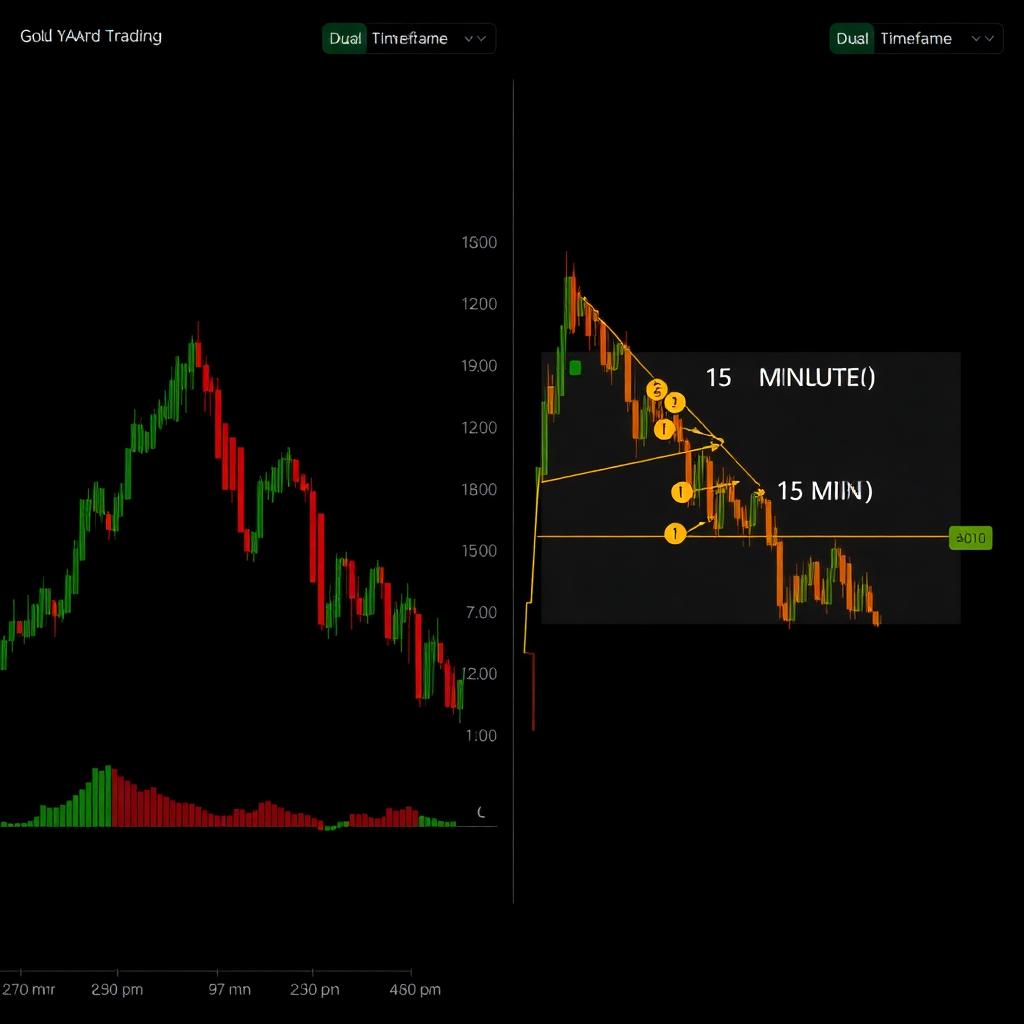
- 15M: Price returns to the 1H OB. Wait for 15M CHoCH down.
- 5M (optional): Enter on the retest of the 5M FVG inside the CHoCH range.
- Stop above the 1H OB high. Target weekly low.
That''s textbook multi-TF SMC.
Killzone alignment
Run this workflow only during killzones:
- London: 07:00–10:00 UTC
- NY AM: 12:30–15:00 UTC
- NY PM reversal: 18:00–20:00 UTC
Outside these windows, sit out.
Where Jenvu fits
The Signal Engine shows live 1H and 15M charts side-by-side with auto-marked structure, OBs, and FVGs — the exact stack above, automated.
FAQ
Is 1H + 15M enough? Yes for intraday. Add 4H for bias.
Can I scalp on 5M alone? Only if the 5M aligns with 1H structure.
Why not use 30M? It''s acceptable but most institutional algorithms prefer 15M and 1H reference points.